

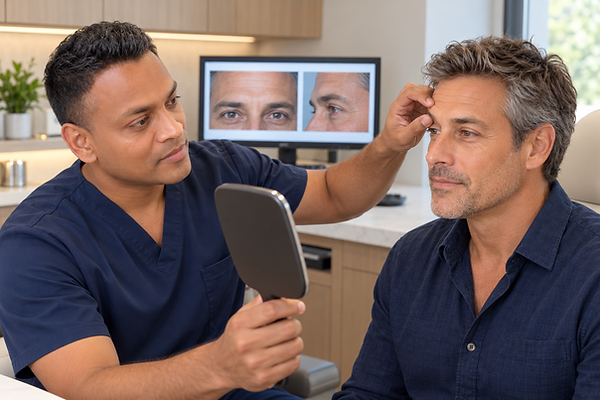
How is male blepharoplasty different than female blepharoplasty?
Great question—there are real, practical differences. The short version: male blepharoplasty aims to refresh without feminizing, so crease height, fullness, and brow position are handled more conservatively and the canthus is kept neutral.

How the surgical plan differs
Upper eyelids (male)
-
Crease placement: usually ~6–8 mm from lash line (customized to ethnicity and native crease). Keep it low and straight, avoid lateral flare.
-
Skin excision: conservative—just enough to clear hooding; over-resection risks feminization and lagophthalmos.
-
Muscle/fat handling: minimal orbicularis excision; preserve central/preaponeurotic fat and often only contour medial fat if bulging. Goal = natural, full upper lid.
-
Brow interplay: men frequently have brow ptosis. If skin redundancy is really brow descent, consider internal browpexy via the upper-lid incision or stage/offer a subtle brow lift; avoid overly arched brows.
Lower eyelids (male)
-
Approach: often transconjunctival for fat contouring to avoid external scar; add a skin pinch if texture/laxity needs it.
-
Fat strategy: favor fat preservation or transposition to the tear trough over removal to prevent hollow “done” look.
-
Support: a canthopexy/canthoplasty is more commonly added in men with laxity to keep the canthus neutral (not elevated).
Natural Healed Eyelid Surgery Portrait

Consultation & Planning Nuances
-
Goal-setting language: Men usually want to look “less tired” but unchanged; align on low crease + subtle platform show.
-
Photography/measurements: document native crease height, brow position relative to the rim, canthal tilt, and lid laxity.
-
Ethnic/racial anatomy: adjust crease height and fat handling accordingly (e.g., lower crease targets in many Asian lids).
-
Medical factors: men are more likely to use aspirin/anticoagulants—optimize cessation plans and emphasize hemostasis.
-
Risks and how they differ in emphasis
-
Hollowing/feminization: higher stakes in men; avoid aggressive fat removal or high creases.
-
Scar visibility: thicker skin can hide well if the incision sits in a true crease; meticulous closure matters.
-
Ectropion/rounding (lower lid): mitigate with canthal support and conservative skin removal.
-
Asymmetry: pre-existing brow asymmetry is common; set expectations.

Frequently Asked Questions
Medically reviewed by Chris Thiagarajah, MD
(ASOPRS) — Oculoplastic Surgeon, Denver Eyelid Specialists.
Published: updated regularly
• Last reviewed: 9/15/2025